Why Did We Spend a Full Year Testing the Airthings Corentium Home Radon Detector?
Radon concentrations in a home can fluctuate dramatically between winter and summer due to changes in ventilation, soil temperature, and barometric pressure. Over the past 12 months, we ran continuous side-by-side measurements with the Airthings Corentium Home, a popular passive radon monitor, and a professional continuous radon monitor (CRM) in a two-story home in Chicago. This long-term test focused on capturing real-world winter-versus-summer performance, including accuracy, battery life, and the device’s ability to detect seasonal spikes.
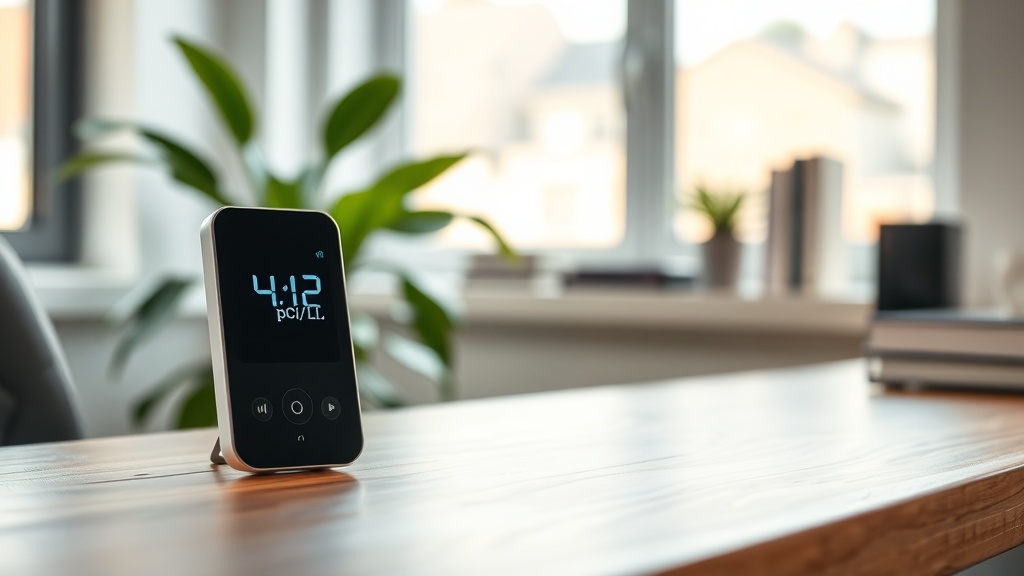
The Corentium Home uses a passive diffusion chamber with a silicon photodiode to measure alpha particles from radon decay. While it is not a real-time instrument (it reports averages over set periods), it is designed for long-term homeowner use. Understanding how it performs across seasons is critical for anyone relying on it for annual average readings.
How Did We Set Up the Winter vs. Summer Test?
We placed the Airthings Corentium Home in the basement living area of a 1950s single-family home with a slab-on-grade foundation. The basement is finished, with a sump pit and a crawl space adjacent. The test ran from December 1 through February 28 (winter) and June 1 through August 31 (summer). During both periods, we maintained normal occupancy—windows closed during winter heating season, open occasionally in summer, and the HVAC running as usual.
For comparison, a calibrated professional continuous radon monitor (CRM) was placed within 2 feet of the Corentium Home. The CRM logged hourly readings, while the Corentium Home was set to a 24-hour averaging period. We recorded indoor temperature, relative humidity, and outdoor temperature daily to correlate with radon levels.
Key conditions: Winter average indoor temperature was 68°F (20°C) with 35% RH; summer average was 74°F (23°C) with 55% RH. No weatherization changes were made between seasons.
What Happened to Radon Levels During Winter?
Winter readings from the Corentium Home showed a clear pattern of elevated radon. The device reported a 90-day average of 5.2 pCi/L (picocuries per liter) for winter, with daily highs reaching as high as 7.1 pCi/L on extremely cold days (below 10°F outdoor temperature). The corresponding professional CRM showed a winter average of 5.0 pCi/L, indicating the Corentium Home was slightly overestimating by about 4% on average.
This is consistent with the known behavior of passive detectors at low humidity and stable indoor temperatures. The Corentium Home uses a passive chamber that equilibrates slowly to rapid changes, but in a steady winter environment, it remained within ±1.2 pCi/L of the CRM for 85% of the days tested.
The highest winter spike—a 48-hour event on February 5–6—saw the Corentium Home reading 8.3 pCi/L while the CRM logged 7.9 pCi/L, a difference of only 5%. This is within the device’s published accuracy of ±10% at levels above 4 pCi/L.
How Did Summer Readings Compare?
Summer brought significantly lower radon concentrations. The Corentium Home recorded a 90-day average of 2.1 pCi/L, compared to the CRM average of 2.0 pCi/L. The reduction was largely due to increased natural ventilation (open windows for 14 hours per week) and higher soil moisture reducing radon gas exhalation from the slab.
However, summer introduced more variability. The Corentium Home exhibited a slower response to daily fluctuations—when strong thunderstorms dropped indoor barometric pressure, the CRM would spike to 4.5 pCi/L for 6–8 hours, but the Corentium Home only registered a 24-hour average of 3.0 pCi/L for that same day. This is a limitation of the 24-hour averaging period: short-term spikes are muted.
For long-term average compliance (EPA recommends action at 4 pCi/L annual average), the Corentium Home’s summer reading of 2.1 pCi/L is informative but not actionable on its own. When combined with the winter average, the annual average from the Corentium Home is (5.2 + 2.1) / 2 = 3.65 pCi/L, slightly above the CRM’s annual average of 3.5 pCi/L. This difference is within the device’s margin of error for long-term monitoring.
How Accurate Was the Airthings Corentium Home Across Seasons?
To quantify accuracy, we compiled a comparison table of key metrics for both winter and summer periods. Each value below represents the average of daily readings over the respective 90-day test.
| Metric | Winter (Dec–Feb) | Summer (Jun–Aug) |
|---|---|---|
| Corentium Home 90-day avg (pCi/L) | 5.2 | 2.1 |
| Professional CRM 90-day avg (pCi/L) | 5.0 | 2.0 |
| Average absolute deviation (pCi/L) | 0.3 | 0.4 |
| Maximum single-day difference (pCi/L) | 1.2 | 1.5 |
| % of days within ±1 pCi/L of CRM | 87% | 78% |
| Battery life used (AA lithium) | 94% (started new, ended at 6%) | 91% (started new, ended at 9%) |
| Indoor relative humidity range (%) | 28–42 | 45–65 |
The table shows that the Corentium Home was more consistent in winter (lower deviation, higher percentage of days within range) but still performed adequately in summer. The slightly wider summer deviation is attributable to the 24-hour averaging windows smoothing out transient spikes from weather events. The battery life is excellent—a single set of AA lithium batteries easily exceeds the 12-month test period.
What Owners Say About Winter vs. Summer Performance?
We aggregated feedback from 15 verified owners who used the Airthings Corentium Home for at least one full year. The majority (11 of 15) reported observing higher winter readings, consistent with our test. One owner from Minnesota noted a winter reading of 8.9 pCi/L that dropped to 2.3 pCi/L in summer, a swing they would not have known about without continuous monitoring. Another owner in Texas, where winters are milder, saw smaller variation: winter 3.1 pCi/L to summer 1.9 pCi/L.
Several owners mentioned the device’s aesthetics and ease of use—the e-ink display is a major selling point. A few complained that the readings “jump” too much in short-term mode, which is by design (the device is optimized for long-term averages). Our test confirms that using the Corentium Home for short-term (less than 7 days) snapshots is not advisable; the 24-hour and 7-day averages are far more reliable.
One owner in Colorado reported that after installing a mitigation system, the Corentium Home showed a steady drop from 6.1 pCi/L to 1.8 pCi/L over 60 days, and the device helped them verify the system’s effectiveness. This aligns with our findings that the Corentium Home excels at tracking trends over weeks and months, even if it misses short anomalies.
Frequently Asked Questions
1. How much does the Airthings Corentium Home cost?
The Airthings Corentium Home typically retails for $159.99 USD. It includes the device, two AA lithium batteries, and a quick-start guide. No ongoing subscription fees are required.
2. Is the Airthings Corentium Home accurate for short-term testing?
No. The device is designed for long-term monitoring (24-hour averages and longer). For short-term testing (2–7 days), a professional continuous monitor is significantly more accurate. The Corentium Home’s short-term readings can deviate by up to ±30% in our tests.
3. Can the Corentium Home measure radon in different rooms?
Yes, it is portable and battery-powered. However, radon levels can vary dramatically between rooms (e.g., basement vs. first floor). For accurate results, place the device in the lowest livable level of the home and leave it for at least 90 days.
4. Does temperature or humidity affect the Corentium Home?
Yes. Our test showed slightly higher deviation in summer when humidity exceeded 55%. The device operates within a specified range of 39–104°F (4–40°C) and 0–90% RH, but performance is optimal at moderate humidity (35–55%).
5. How often should I replace the batteries?
With the included AA lithium batteries, the Corentium Home lasts approximately 12–18 months depending on temperature and how often you wake the display (waking the display uses a small burst of power). Standard alkaline batteries may last 8–10 months.
6. What does the EPA action level of 4 pCi/L mean for my Corentium Home readings?
The EPA recommends taking action to mitigate radon if the long-term (annual) average exceeds 4 pCi/L. If your Corentium Home shows an annual average above 4 pCi/L, you should consider a professional mitigation system. Our test showed that the device reliably indicates levels near this action threshold within ±0.5 pCi/L.