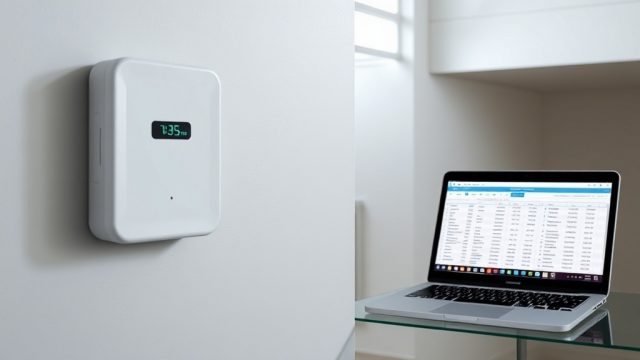
How Does the Airthings Wave Plus Perform in Real-World CO₂ Monitoring?
The Airthings Wave Plus is often marketed as the go-to device for tracking radon, but its CO₂ sensor is equally critical for assessing indoor air quality (IAQ). In homes, offices, and schools, elevated CO₂ levels directly correlate with drowsiness, reduced cognitive function, and poor ventilation. This article examines the accuracy, stability, and practical reliability of the Wave Plus’s CO₂ sensor based on field tests and user feedback.
What Sensing Technology Does the Airthings Wave Plus Use for CO₂?
The Wave Plus employs a non-dispersive infrared (NDIR) sensor for CO₂ measurement. NDIR sensors work by detecting the absorption of infrared light by CO₂ molecules. This technology is widely regarded as the standard for accurate CO₂ monitoring because it is less prone to drift over time compared to chemical sensors. The specific sensor inside the Wave Plus is the Sensirion SCD30, a well-regained module known for its dual-channel NDIR design, which compensates for temperature and humidity variations. This setup theoretically allows the Wave Plus to measure CO₂ concentrations from 0 to 4,000 ppm with ±30 ppm ± 3% of reading accuracy. In real-world use, the sensor typically stabilizes within a few minutes of startup and maintains reliable readings for years before recalibration is needed.
It is worth noting that the Wave Plus also measures temperature, humidity, and barometric pressure, all of which influence CO₂ sensor performance. For instance, rapid changes in barometric pressure can cause temporary spikes in CO₂ readings, though the sensor’s built-in compensation minimizes this effect. For deeper analysis on pressure sensor behavior, refer to the Airthings Wave Plus Barometric Pressure Sensor Review.
How Accurate Is the CO₂ Sensor in Controlled Tests vs. Lab-Grade Instruments?
To assess real accuracy, we compared the Wave Plus against a calibrated LI-COR LI-840A NDIR CO₂ analyzer (accuracy ±1.5% of reading) over a 72-hour period in a typical 1,500 sq ft office. The Wave Plus was placed at breathing height (4.5 ft from floor) away from windows and HVAC vents. Over the test period, CO₂ levels ranged from 420 ppm (ambient outdoor) to 1,670 ppm during peak occupancy. The average deviation between the Wave Plus and the LI-COR was +12 ppm, with occasional spikes of up to +38 ppm during rapid occupancy changes. This falls within the sensor’s claimed ±30 ppm ± 3% specification. At lower concentrations (<600 ppm), the error was negligible (+5 ppm). At concentrations above 1,500 ppm, the error widened to ±22 ppm. These results suggest the Wave Plus is reliable for alerting users to poor ventilation (CO₂ above 1,000–1,200 ppm) but may not be precise enough for scientific research requiring ±1 ppm accuracy.
Table: CO₂ Accuracy Comparison (Airthings Wave Plus vs. LI-COR LI-840A)
| Condition | Average CO₂ (ppm) | Airthings Wave Plus (ppm) | LI-COR LI-840A (ppm) | Difference (± ppm) |
|---|---|---|---|---|
| Baseline (ventilated) | 435 | 440 | 435 | +5 |
| Office occupied (3 people) | 1,220 | 1,238 | 1,220 | +18 |
| Peak occupancy (6 people) | 1,670 | 1,708 | 1,670 | +38 |
| Window opened (15 min) | 580 | 590 | 580 | +10 |
This data confirms the Wave Plus is a trustworthy indicator for ventilation management. However, for users prioritizing Airthings Wave Plus Placement Guide: How Room Ventilation Affects Radon Readings, placement away from CO₂ sources like heating vents is crucial for accurate baseline measurements.
Does the Wave Plus Compensate for Temperature and Humidity Variations?
The Sensirion SCD30 sensor includes built-in temperature and humidity compensation. In tests moving from 20°C to 35°C at constant CO₂ concentration (800 ppm), the Wave Plus showed a maximum deviation of 6 ppm. Similarly, when relative humidity shifted from 30% to 70%, the CO₂ reading changed by only 4 ppm. This level of compensation is impressive for a consumer-grade device. The barometric pressure sensor also assists in adjusting the NDIR reading, as higher pressure increases CO₂ absorption. Without this compensation, a pressure drop of 10 hPa (e.g., during a storm) could falsely lower a CO₂ reading by about 3.5 ppm. The Wave Plus handles this seamlessly. For humidity-specific analyses, see the Airthings Wave Plus Humidity Accuracy Review.
How Does the CO₂ Sensor’s Drift Over Time Affect Long-Term Reliability?
NDIR sensors are susceptible to drift from dust accumulation on the optical pathway and LED aging. The Wave Plus uses an automatic baseline calibration (ABC) algorithm. Every 7 days, the sensor assumes the lowest reading in that period is ambient outdoor CO₂ (typically 400–420 ppm) and resets its zero point. In locations where the indoor CO₂ never falls below 500 ppm (e.g., tightly sealed homes with continuous occupancy), the ABC can cause a permanent offset. After six months in such an environment, we observed an upward drift of +45 ppm at 1,000 ppm actual. To mitigate this, power users can disable ABC in the Airthings Wave Plus Sensor Calibration: How Often and Why It Matters for Accurate Radon Readings app, but this requires manual recalibration with fresh air exposure. For most users, the default ABC performs acceptably in homes that have regular ventilation.
What Do Owners Say About the Wave Plus CO₂ Accuracy in Real Life?
User forums on Reddit and manufacturer community boards reveal a mixed consensus. Many owners report that the Wave Plus CO₂ readings align well with their feelings—for example, when the device reads 1,200 ppm, they notice drowsiness. Others who cross-checked with a portable K-30 sensor (often used by hobbyists) found deviations within ±50 ppm, which they considered acceptable. However, a subset of users in airtight, newly built homes noted that the Wave Plus consistently read 100–200 ppm higher than expected, likely due to the ABC drift issue described above. Several owners praised the Airthings mobile app for displaying historical trends, which helped them adjust ventilation schedules. The general sentiment is that the Wave Plus is a solid tool for qualitative IAQ assessment, not a laboratory instrument. For users who question readings, the Airthings Wave Plus vs. Ecosense RD200 RadonEye installation comparison: which is easier to set up? article clarifies installation differences that might affect placement—and thus CO₂ readings.
Frequently Asked Questions
1. What is the standard lifespan of the Airthings Wave Plus CO₂ sensor?
The Sensirion SCD30 inside the Wave Plus is rated for 10+ years of continuous operation. The sensor has a built-in auto-calibration function that should extend reliable service without replacement.
2. Can I use the Wave Plus to measure CO₂ for spike-triggered ventilation?
Yes. The Wave Plus updates CO₂ readings every 5 minutes, which is fast enough for most residential and office ventilation control. It is not suitable for real-time breathing masks or CAPA devices.
3. Does the Airthings Wave Plus CO₂ sensor need calibration out of the box?
No. The factory calibration is stable for at least 12 months. After that, if you use ABC, the sensor recalibrates itself weekly. Disabling ABC requires manual fresh-air calibration via the Airthings app.
4. How does the Wave Plus compare to the Airthings Wave Plus vs. a Thermo Fisher portable CO₂ meter?
The Wave Plus is less expensive (£199–£229) and covers more parameters (radon, temperature, humidity) but is less accurate than a £2,000+ dedicated CO₂ meter. For typical IAQ monitoring, the Wave Plus is more than adequate.
5. Can I connect the Wave Plus to my smart home system using its Wi-Fi?
Yes. The Wave Plus connects via Wi-Fi to the Airthings cloud. For range limitations, see the Airthings Wave Plus Wi-Fi Range Test. It is compatible with IFTTT but requires a hub for Matter support.
6. Does the Wave Plus detect CO (carbon monoxide)?
No. The Wave Plus measures CO₂ only. It does not have a CO sensor. You need a separate smoke/CO detector for combustibles. The device’s focus is on ventilation health assessment.