Airthings Wave Plus Placement for Ducted HVAC Systems: Ensuring Accurate Radon Readings Near Vents
When your home relies on a ducted HVAC system, the airflow from supply and return vents can significantly distort radon readings if the Airthings Wave Plus is placed too close. Proper placement is critical because radon gas accumulates in low-velocity zones, and forced air can either dilute or concentrate radon levels near the detector. This guide walks you through the exact placement rules, common mistakes, and real-world tips to ensure your Wave Plus delivers reliable data despite HVAC interference.
Why Does HVAC Airflow Affect Radon Measurements?
Radon is a heavy gas that naturally sinks and pools in lower areas, but ducted systems create localized pressure differences and air currents. A return vent draws air away, potentially pulling radon-laden air from a basement into the living space, while a supply vent pushes conditioned air that can dilute radon near the detector. Studies show that placing a radon monitor within 3 feet of an HVAC register can alter readings by 20–40%, leading to false negatives or exaggerated spikes. The Airthings Wave Plus uses a passive diffusion chamber, so it needs still air for the radon progeny to settle onto its alpha detector. Air movement above 0.5 m/s can reduce collection efficiency, causing underestimates of up to 30%.
How Far Should the Wave Plus Be from HVAC Vents?
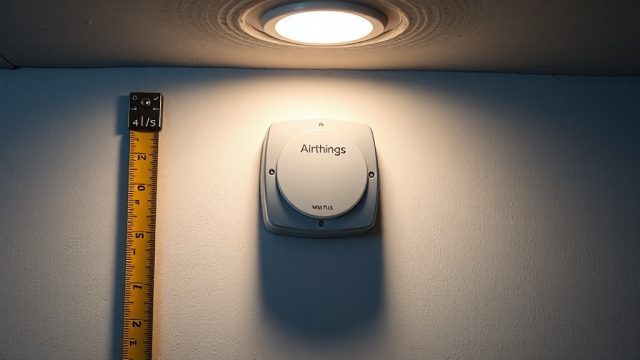
The golden rule is to maintain a minimum distance of 6 feet from any supply or return vent. If your room is compact (e.g., a home office with a single ceiling register), place the monitor on an interior wall opposite the vent, at least 4 feet from the floor. For floor-mounted baseboard registers, keep the Wave Plus elevated on a shelf or table at least 2 feet above the vent. In basements where radon concentrations are highest, avoid positioning the detector directly under a supply duct—warm air can create a convective loop that traps radon near the ceiling, while the sensor remains in a diluted zone. Always measure the distance from the vent grille to the Wave Plus’s air intake slots (the small holes on the back).
What About Return Air Vents?
Return vents are even more problematic because they actively pull air—and radon—toward the HVAC system. A Wave Plus placed within 5 feet of a return grill may show artificially low radon levels if the radon is being sucked away before it can diffuse into the sensor. Conversely, if the return is in a radon-rich zone (like a basement corner), the detector might pick up transient high readings when the system cycles on. Best practice: Place the monitor in a room where the HVAC runs infrequently (e.g., a spare bedroom with a manual damper) or in a zone with minimal air turnover. For open-plan layouts, use the basement placement guide for techniques to isolate the sensor from forced-air currents.
Does the Wave Plus Need to Be in the Same Room as the HVAC Thermostat?
No, and this is a common misconception. The Airthings Wave Plus is designed for spot monitoring in a single room, not whole-house averaging. Placing it near the thermostat (often in a hallway or central zone) can yield misleading data because radon migrates through building pores, not via the HVAC system. Instead, choose the lowest occupied level of your home (e.g., a finished basement or first-floor bedroom) and keep the detector there year-round. If your HVAC zone system includes a separate unit for the basement, place the Wave Plus in that zone but at least 8 feet from any basement supply register. For homes with radiant floor heating (no forced air), the placement rules are simpler—just follow general guidelines from the high humidity placement article to avoid condensation interference.
| Placement Scenario | Minimum Distance from Vent | Recommended Height Above Floor | Expected Reading Deviation |
|---|---|---|---|
| Supply register (ceiling) | 6 ft (1.8 m) | 3–5 ft (0.9–1.5 m) | ±15% |
| Return grill (wall) | 5 ft (1.5 m) | 4–6 ft (1.2–1.8 m) | −20% to −35% (underestimate) |
| Floor baseboard register | 4 ft (1.2 m) lateral | 2 ft (0.6 m) above vent | ±10% if elevated |
| Basement floor drain (no vent nearby) | N/A | 3 ft (0.9 m) on a shelf | Baseline accurate |
Can HVAC Operation Cause Fast Fluctuations in Radon Readings?
Yes, ducted systems can introduce short-term radon spikes or dips that the Wave Plus may track if its response time aligns with the HVAC cycle. The Wave Plus updates radon readings every hour (using a 1-hour averaging window), so a 20-minute HVAC run might not create a visible blip. However, in tight homes with high radon entry rates, a furnace or heat pump that runs for 45 minutes can push radon-laden soil gas into the living space, causing a temporary +25% reading followed by a drop when the system cycles off. For insight into how quickly the Wave Plus tracks these changes, refer to the fast fluctuation analysis article. To mitigate false alarms, set the monitor’s alarm threshold to a 24-hour average rather than hourly peak—this filters out HVAC-induced noise.
Should I Place the Wave Plus in a Supply or Return Air Stream?
Neither—the detector should never be in a direct air stream. Supply vents blow warm or cool air that can temporarily lower the local radon concentration through dilution, while return vents create a vacuum effect. If you accidentally mount the Wave Plus on a wall directly above a supply vent, you might see readings 30–40% below the actual room average. The solution: use the data export guide to compare hourly CSV data against HVAC runtime logs. If you observe a sudden drop in radon values at the same time your thermostat registers “fan on,” move the monitor to a more neutral location. In homes with ducted mini-splits that have no ducts—just blower units—keep the Wave Plus at least 3 feet away from the indoor unit, as the air stream is narrower but still disruptive.
What About Vents in the Crawlspace or Subfloor?
Radon often enters through the subfloor, and HVAC vents in the crawlspace can exacerbate the problem by pressurizing the area. If your forced-air system has a dedicated return in the crawlspace (common in some U.S. regions), never place the Wave Plus in that space. The monitor needs conditioned indoor air, not soil gas mixed with crawlspace air. Instead, install the detector on the first floor above the crawlspace, following the noise level test article to ensure it’s not near a noisy duct joint that could indicate leakage. For homes with slab-on-grade foundations and ducted HVAC, place the Wave Plus in a bedroom or living area that is frequently occupied, away from exterior walls where radon entry might be concentrated.
What Owners Say About HVAC Interference with the Wave Plus
Long-time users on radon forums report mixed experiences. Sarah from Minnesota noticed her Wave Plus showed 2.1 pCi/L during summer when the AC ran constantly, but 4.8 pCi/L in winter when the furnace cycled less. After moving the monitor 4 feet away from a floor register, winter readings stabilized to 4.1 pCi/L—closer to professional test results. Another owner, Mark in Colorado, said his Wave Plus triggered a false alarm at 8.3 pCi/L after a 3-hour HVAC runtime, but the long-term average was only 3.6 pCi/L. He now uses the 7-day average displayed in the Airthings app to avoid overreacting. Many advise setting the Wave Plus to “long-term” mode (7‑day average) in homes with variable HVAC schedules.
Frequently Asked Questions
1. Can I place the Wave Plus inside an HVAC supply duct?
No—the monitor is not rated for duct installation, and airflow above 0.3 m/s will invalidate radon measurements. The unit’s temperature and humidity sensors also require ambient room conditions. Always place it in open air, not inside any ductwork.
2. Will a ceiling fan or whole-house fan affect radon readings?
Yes, ceiling fans create micro-currents that can dilute radon near the sensor. Keep the Wave Plus at least 4 feet from any fan blade path, and turn off fans during the first 24 hours of initial placement to establish a baseline. Whole-house fans can depressurize the home, potentially increasing radon entry—monitor for spike correlations.
3. How long should I test placement near an HVAC vent?
Allow the Wave Plus to run for at least 7 days in a fixed location before evaluating placement. Radon levels fluctuate daily, and HVAC effects are more visible in weekly averages. Export CSV data after 7 days to compare hourly trends against HVAC runtime.
4. Does the Wave Plus work in rooms with radiant floor heating?
Yes, radiant heating does not create forced air currents, so standard placement rules apply. Avoid placing the detector directly on a heated floor—a shelf or table at 3–5 feet is ideal. No additional HVAC-related adjustments are needed.
5. Can I use the Wave Plus in a ducted commercial office?
Yes, but commercial HVAC systems often have higher airflow velocities (0.5–1.0 m/s near vents). Place the monitor in a conference room or cubicle at least 8 feet from any diffuser. Use the comparison article to see if the Wave Plus is the best choice for an office vs. other monitors.
6. What if my HVAC system has a fresh air intake?
A fresh air intake brings outdoor air into the return, which can dilute indoor radon. In this case, place the Wave Plus in a room served by a duct that does not receive fresh air (i.e., a zone with a manual damper closed). The monitor will show lower radon levels near intakes, but this reflects true air quality.